Introduction
The Hatshepsut Temple is one of the most remarkable ancient monuments in Luxor, Egypt. Set against towering desert cliffs on the West Bank of the Nile, this impressive structure tells the story of a woman who rose to become one of ancient Egypt’s most powerful rulers.
Queen Hatshepsut ruled during the 18th Dynasty of the New Kingdom, around 1473–1458 BC. She became pharaoh at a time when kingship was traditionally represented as a male role. Through political skill, ambitious building projects, and successful trade expeditions, she established a lasting place in Egyptian history.
Today, the Hatshepsut Temple attracts visitors with its elegant terraces, impressive columns, and beautifully decorated walls. However, its importance goes far beyond its architecture. The monument also reveals how Hatshepsut presented her royal authority and honored the gods of ancient Egypt.
In this guide, you will discover the story of Queen Hatshepsut, the history of her temple, its most interesting features, and practical tips for visiting this extraordinary site.
1. Who Was Queen Hatshepsut?
Queen Hatshepsut was the daughter of Pharaoh Thutmose I and Queen Ahmose. She married her half-brother, Thutmose II, who later became king of Egypt.
When Thutmose II died, his son Thutmose III was still young. Hatshepsut initially acted as regent, helping govern Egypt on behalf of the young king. However, she later adopted the full royal title of pharaoh and ruled alongside Thutmose III.
Her rise to power was unusual, but she successfully presented herself as Egypt’s legitimate ruler. She used royal titles, traditional kingly images, religious ceremonies, and monumental construction to strengthen her position.
Hatshepsut’s reign is associated with economic prosperity, major building projects, and renewed trade connections. Rather than focusing only on military expansion, she invested heavily in architecture and religious monuments.
Her legacy remains significant because she demonstrated that a woman could exercise the highest level of political authority in ancient Egypt.
2. Where Is Hatshepsut Temple Located?
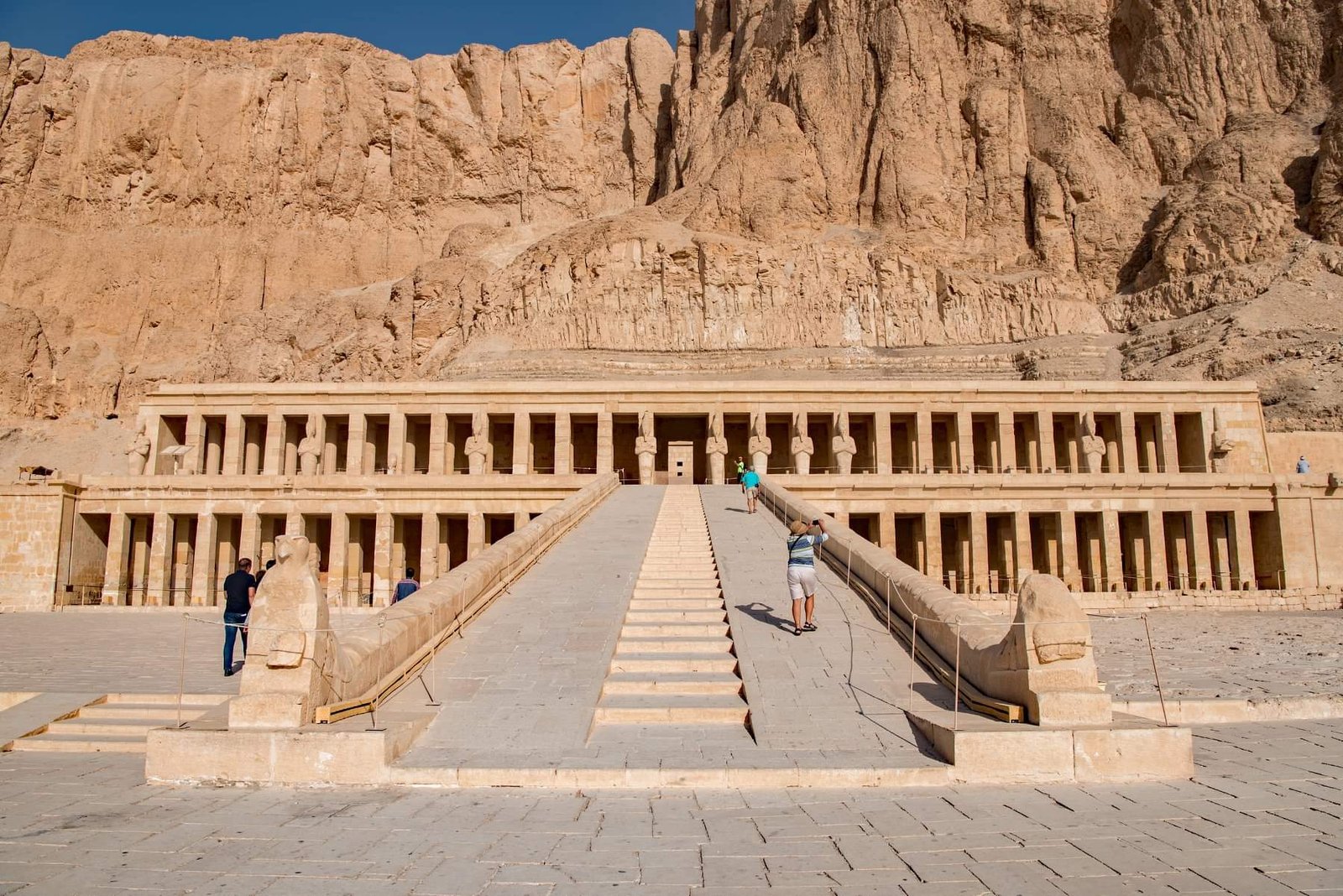
Hatshepsut Temple stands at Deir el-Bahari on the West Bank of Luxor, near the Valley of the Kings and other important archaeological sites.
The location was already sacred before Hatshepsut began building her monument. Earlier Egyptian rulers had constructed funerary monuments in the same area, which was associated with religious beliefs and the afterlife.
The temple faces the Nile’s eastern side, where Karnak Temple once served as a major center of worship for the god Amun.
Its position beneath enormous limestone cliffs creates one of the most distinctive landscapes in Luxor. The natural rock formations also provide a dramatic background for the temple’s carefully arranged terraces.
For visitors, this setting makes the monument especially impressive. The contrast between the pale stone architecture, surrounding desert, and steep cliffs creates excellent opportunities for photography.
3. Why Did Hatshepsut Build the Temple?
Hatshepsut’s temple was designed as a mortuary temple, a religious monument where ceremonies honored the deceased ruler and supported the cult associated with the afterlife.
Its ancient Egyptian name was Djeser-Djeseru, commonly translated as “Holy of Holies” or “Sacred of the Sacred.”
The temple was dedicated primarily to Amun, one of the most important gods of ancient Egypt. It also included areas associated with Hathor, Anubis, Ra-Horakhty, and Hatshepsut’s father, Thutmose I.
However, the temple served another important purpose. Its reliefs and inscriptions helped communicate Hatshepsut’s legitimacy as pharaoh.
Some scenes present her divine birth, while others explain her royal ancestry and connection with the god Amun. These images were not simply decorations. They formed part of a carefully planned message about her right to rule Egypt.
The temple therefore combined religious devotion, royal commemoration, and political symbolism.
4. The Remarkable Architecture of Hatshepsut Temple
One of the most striking features of Hatshepsut Temple is its design. Unlike many Egyptian temples dominated by monumental gateways and enclosed courtyards, this complex features three broad terraces connected by ramps.
The terraces rise gradually toward the cliffs, creating a strong sense of symmetry and harmony with the natural landscape.
The Lower Terrace
The lower level forms the entrance to the main temple complex. In ancient times, an approach led visitors toward the monument, connecting the temple with its wider religious setting.
Today, visitors can appreciate the long architectural lines and the way the structure gradually rises toward the mountain.
The Middle Terrace
The middle terrace contains important colonnades and some of the temple’s most famous reliefs.
Here, scenes from Hatshepsut’s expedition to the Land of Punt provide valuable information about trade and foreign contacts. Other decorations describe aspects of her royal authority and divine birth.
Take time to examine these walls closely. They reveal details about ancient Egyptian clothing, ships, landscapes, animals, and religious beliefs.
The Upper Terrace
The upper terrace contains an impressive courtyard surrounded by columns and statues.
At the far end, a passage cut into the rock leads toward the sanctuary of Amun. This arrangement connects the man-made temple with the sacred mountain behind it.
The upper level is also an excellent place to appreciate the monument’s scale and the cliffs that surround it.
Together, the three terraces demonstrate the remarkable planning and craftsmanship of ancient Egyptian builders.
5. Hatshepsut’s Expedition to the Land of Punt
One of the most fascinating stories carved into the temple walls is Hatshepsut’s expedition to the Land of Punt.
Punt was an important trading region whose precise location remains debated, although it is generally associated with areas around the southern Red Sea and the Horn of Africa.
The expedition brought valuable goods back to Egypt. These included aromatic resins, ebony, ivory, spices, and other materials prized by Egyptian temples and royal households.
The temple reliefs show ships, foreign settlements, people, and products associated with the journey. As a result, they offer an important visual record of ancient Egyptian trade.
The expedition also helped Hatshepsut demonstrate the prosperity and international connections of her reign.
For modern visitors, these scenes provide a glimpse of a world connected by travel, commerce, diplomacy, and the exchange of valuable goods.
6. The Mystery of Hatshepsut’s Disappearance from History
Hatshepsut ruled for approximately two decades, leaving behind a substantial architectural and artistic legacy. Yet some of her statues and inscriptions were later damaged or removed.
For many years, scholars debated why her memory was targeted. Some suggested that Thutmose III had ordered the destruction because he resented her rule.
However, the evidence is more complicated. Much of the damage appears to have occurred after Hatshepsut’s death, and researchers continue to examine the political and religious reasons behind these actions.
The destruction was not necessarily a simple attempt to erase every trace of her existence. Some alterations may have reflected concerns about royal succession, the legitimacy of kingship, or the presentation of Egypt’s royal history.
Despite this damage, many inscriptions and monuments survived. Archaeological research has helped historians reconstruct Hatshepsut’s reign and recognize her importance as a ruler.
Her story is now an essential part of understanding the political and cultural history of ancient Egypt.
7. What Can You See at Hatshepsut Temple Today?
A visit to Hatshepsut Temple offers much more than a view of its famous terraces. Several features deserve special attention.
- The three terraces: Notice how each level rises toward the cliffs and creates a balanced architectural composition.
- The colonnades: Examine the rows of columns that frame the temple’s open spaces.
- The Punt expedition reliefs: Look for scenes illustrating ships, trade goods, and foreign landscapes.
- The divine birth scenes: Discover how the temple presented Hatshepsut’s connection with Amun.
- The statues of Hatshepsut: Some portray the ruler in traditional royal or Osirian forms.
- The sanctuary of Amun: Follow the central axis toward the sacred area cut into the rock.
- The surrounding cliffs: Take time to appreciate the natural setting that makes Deir el-Bahari so distinctive.
A knowledgeable Egyptologist can help explain the religious symbols and historical events depicted on the walls. Without context, some scenes may look similar, but their stories are often very different.
8. How to Visit Hatshepsut Temple in Luxor
Hatshepsut Temple is usually included in West Bank sightseeing tours. Many travelers combine it with the Valley of the Kings and the Colossi of Memnon.
Best Time to Visit
The cooler months, from October to April, are generally comfortable for exploring Luxor’s archaeological sites.
Early morning is often a good choice because temperatures are usually lower than in the afternoon. It can also provide attractive lighting for photography.
During summer, Luxor can become extremely hot. If you visit between June and September, carry water, wear sun protection, and take breaks whenever necessary.
How Much Time Do You Need?
Allow approximately one to two hours to explore the temple, depending on your interest in the reliefs, photography, and guided explanations.
If you plan to visit several West Bank attractions on the same day, allow additional time for transport, entrance procedures, and breaks.
What Should You Wear?
Wear comfortable walking shoes because the site involves walking across open areas and stone surfaces.
Lightweight clothing, a hat, sunglasses, and sunscreen are useful in the Egyptian sun. Bring water, particularly during warmer months.
Should You Hire a Guide?
A licensed Egyptologist can make your visit more informative by explaining the temple’s architecture, religious scenes, and Hatshepsut’s political history.
If you prefer independent sightseeing, consider reading about the main reliefs before your visit. This preparation can help you understand the stories represented on the walls.
Before travelling, confirm current opening hours, ticket prices, and access arrangements through the official Egyptian monuments website.
9. Combine Hatshepsut Temple with Other Luxor Attractions
Hatshepsut Temple is an excellent starting point for discovering the history of ancient Thebes.
Valley of the Kings: Explore the royal burial ground where generations of pharaohs were laid to rest. Its decorated tombs reveal ancient Egyptian beliefs about death and the afterlife.
Colossi of Memnon: See the two monumental statues that once stood before the mortuary temple of Amenhotep III.
Valley of the Queens: Discover a royal burial area associated with queens, princes, and princesses. The site offers another perspective on royal life and funerary traditions.
Karnak Temple: Visit one of ancient Egypt’s largest religious complexes, located on Luxor’s East Bank. Its monumental columns, obelisks, and sacred precincts demonstrate the importance of Amun’s cult.
Luxor Temple: Explore a temple closely connected with royal ceremonies and the religious life of ancient Thebes.
For a well-organized day, combine Hatshepsut Temple with two or three nearby West Bank attractions. If you also want to visit Karnak or Luxor Temple, consider allowing additional time or arranging a separate East Bank visit.
You can explore more options in our Full Day East and West Luxor Tour and Luxor West Bank Tour guides. Replace these sample internal links with the correct published URLs on your website if needed.
10. Why Hatshepsut Temple Is Worth Visiting
Hatshepsut Temple is worth visiting because it brings together architecture, religion, art, and the story of an extraordinary ruler.
Its terraces show how ancient Egyptians designed monumental buildings around their natural surroundings. Its reliefs preserve details of trade expeditions, religious ceremonies, and royal ideology.
Most importantly, the temple provides a powerful connection to Hatshepsut herself. Her reign challenged traditional expectations of kingship, while her building projects helped secure her place in Egyptian history.
Whether you are interested in archaeology, ancient architecture, photography, or the lives of Egypt’s pharaohs, this monument offers a rewarding experience.
A visit also helps you understand why Luxor remains one of the most important destinations for exploring the civilization of ancient Egypt.
Frequently Asked Questions
Who was Queen Hatshepsut?
Hatshepsut was a ruler of Egypt’s 18th Dynasty who became pharaoh around 1473 BC. She is remembered for her major building projects, trade expeditions, and unusual rise to royal power.
Where is Hatshepsut Temple located?
The temple is located at Deir el-Bahari on Luxor’s West Bank, near the Valley of the Kings.
How old is Hatshepsut Temple?
The temple dates to the 15th century BC, making it approximately 3,500 years old.
Why is Hatshepsut Temple famous?
It is famous for its three terraces, dramatic cliffside setting, detailed reliefs, and connection with one of ancient Egypt’s most notable female rulers.
How long should I spend at Hatshepsut Temple?
Most visitors should allow around one to two hours. History enthusiasts may want more time to study the reliefs and architectural details.
Can I visit Hatshepsut Temple and the Valley of the Kings on the same day?
Yes. Both attractions are on Luxor’s West Bank and are commonly combined in a full-day sightseeing itinerary. You should allow extra time for travel, tickets, and other planned stops.
What is the best time to visit Hatshepsut Temple?
October through April generally offers more comfortable weather. Early morning is often preferable, especially during the warmer months.
Is Hatshepsut Temple suitable for photography?
Yes. Its terraces, columns, cliffs, and reliefs provide many interesting photographic subjects. Follow the current photography rules and any restrictions inside specific areas.
Final Thoughts
The Hatshepsut Temple is more than an architectural masterpiece. It is a lasting reminder of a remarkable woman who ruled ancient Egypt and left a significant mark on its history.
From the elegant terraces at Deir el-Bahari to the detailed scenes of the Land of Punt, every part of the monument offers clues about the world Hatshepsut shaped.
When you visit Luxor, take time to explore this extraordinary temple and learn the story behind its walls. Understanding Hatshepsut’s life and achievements will make your journey through ancient Egypt even more meaningful.